

Table of Contents
- AeroPress vs V60 for Light Roast Coffee: Which Brewer Wins?
- Quick Comparison: AeroPress vs V60 at a Glance
- Cup Profile: Clarity, Body, and How Origin Characteristics Come Through
- The Best Brew Method for Light Roast Coffee: Immersion vs Pour-Over
- Light Roast Coffee Grind Size: What Each Brewer Needs
- AeroPress Light Roast Recipe for a Sweet, Full Cup
- V60 Light Roast Recipe for a Clean, Bright Cup
- Troubleshooting: Fixing Sour, Bitter, or Thin Light Roast Coffee
- Frequently Asked Questions
Last Updated: October 12, 2026
AeroPress vs V60 for Light Roast Coffee: Which Brewer Wins?
Light roast coffee is the hardest test of any brewer: denser, less soluble, and far less forgiving than dark roasts. This guide from EmperRoar Coffee breaks down the aeropress vs v60 debate for light roast, with matched recipes, grind settings, and troubleshooting.
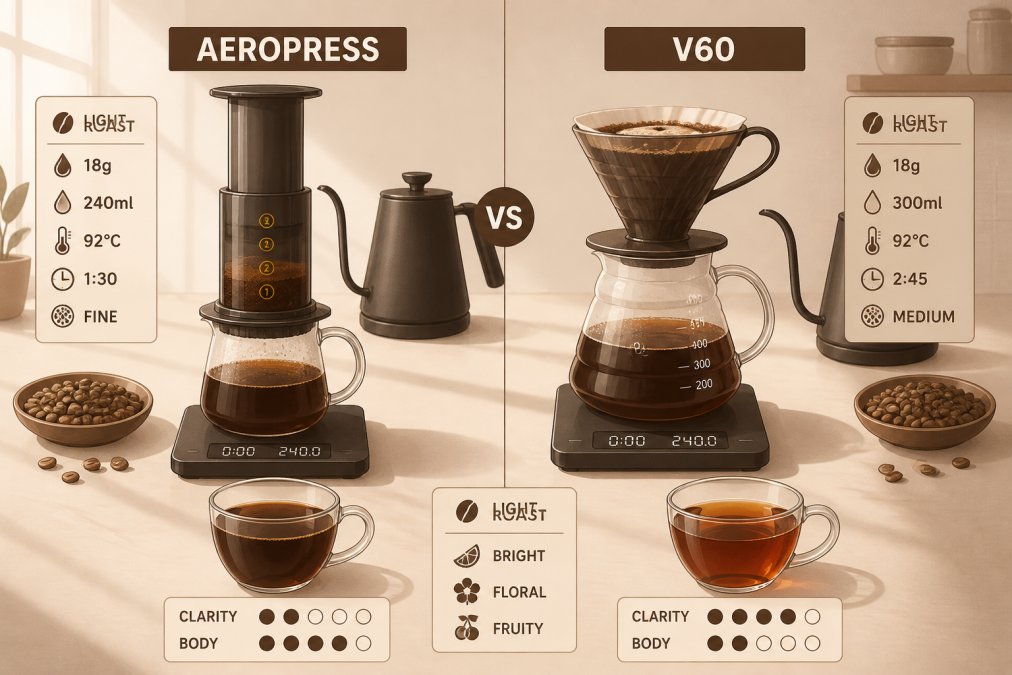
The short answer: the V60 wins on clarity and origin character, while the AeroPress wins on body, sweetness, and forgiveness. The AeroPress is a full-immersion brewer: the coffee steeps before you press it through a filter.
Quick Comparison: AeroPress vs V60 at a Glance
The table below summarizes how each brewer behaves with a light roast.
| Factor | AeroPress | V60 |
|---|---|---|
| Brew style | Immersion plus pressure | Pour-over |
| Filter | Paper (thin) or metal | Paper (thin, cone) |
| Grind size | Medium-fine | Medium |
| Typical brew time | 1:30 to 2:30 | 2:30 to 4:00 |
| Cup profile | Full body, rounded sweetness | Clean cup, high clarity |
| Acidity and brightness | Muted, integrated | Pronounced, separated |
| Learning curve | Forgiving, hard to ruin | Steep, technique-sensitive |
| Best for | Sweet, heavy cups and small batches | Bright, tea-like light roasts |
Both use paper filters, but the geometry differs. The AeroPress uses a small circular filter and a short, wide bed. The V60 uses a cone-shaped filter with a large single hole at the base, and its ribbing shapes how fast water drains.
Cup Profile: Clarity, Body, and How Origin Characteristics Come Through
Cup clarity is the V60's home turf. Because water flows through the bed once, it separates flavors instead of blending them, so a washed Ethiopian reads as floral and citrus-forward. The AeroPress steeps the grounds, building body while softening a light roast's sharp edges.
Here is how the two cups typically differ on the same beans:
- Aroma: Both deliver it, but the V60 pushes delicate top notes forward.
- Acidity: The V60 shows brightness and snap; the AeroPress rounds it into sweetness.
- Body: The AeroPress gives a heavier, silkier mouthfeel; the V60 stays light and tea-like.
Acidity, Brightness, and Aroma in the Cup
Brightness is perceived acidity, and light roasts are prized for it. The V60 amplifies it: fast flow and thin paper let acids and aromatics reach the cup intact. The AeroPress tempers them. If a light roast tastes sharp or sour, the AeroPress is safer; if you chase that electric, juicy snap, the V60 delivers it more reliably.
The Best Brew Method for Light Roast Coffee: Immersion vs Pour-Over
The best brew method for light roast coffee depends on what you want from the cup, not on which brewer is superior. Immersion, used by the AeroPress, gives every particle equal contact with water, producing even extraction and a sweet, full-bodied result.
That distinction matters more with light roast than any other level. Light roast beans are dense and resist giving up solubles, so they need more contact time or more agitation.
A Controlled Side-by-Side Light Roast Tasting
Most comparisons rely on memory, mood, or a single cup brewed on a different day. To learn which brewer suits a light roast, hold everything constant except the brewer.
Hold these constant:
- Coffee: One light roast, ideally a washed single origin with clear acidity, such as a Kenyan or Ethiopian washed lot. Use the same bag for both brews.
- Dose: 15 g in each brewer. Weigh, do not scoop.
- Water: The same water, from the same kettle, at the same temperature. 96°C is a good target for light roast.
What to record:
- Aroma: Which cup pushes floral or fruit notes forward first?
- Acidity: Is the brightness sharp and separated, or rounded into sweetness?
- Body: Is the mouthfeel tea-like and light, or silky and heavier?
What you will typically find: The V60 separates the light roast into distinct layers, so a washed Ethiopian reads as floral on the front and citrus on the finish. The AeroPress merges those layers into a single rounded sweetness.
Why This Test Beats Reading Reviews
A brewer does not have a fixed flavor, it has a range, and the coffee, water, and technique decide where you land. A matched side-by-side test removes the noise and shows the mechanical difference: immersion builds body and rounds acidity, while percolation preserves separation and clarity.
Light Roast Coffee Grind Size: What Each Brewer Needs
Light roast coffee grind size is the biggest lever you control, and the two brewers want different settings. The AeroPress needs medium-fine, close to table salt, because the short brew relies on surface area. The V60 needs medium, closer to coarse sand, because too fine a grind clogs the paper and stalls the drawdown.
A useful starting point for both brewers is a coffee-to-water ratio between 1:15 and 1:17. From there, adjust one variable at a time:
- Sour or weak? Grind finer to extract more.
- Bitter or harsh? Grind coarser to extract less.
- V60 draining too slowly? Coarsen the grind or pour more gently.
Keep your dose and water volume fixed while you adjust grind. Changing two things at once tells you nothing.
Strength and Extraction Yield Are Not the Same Thing
Most grind advice collapses two separate measurements into one, which is why so many light roast cups disappoint.
A cup can be strong and under-extracted at once: heavy and syrupy but also sour and hollow.
A practical way to separate the two:
- If the cup tastes weak but clean and sweet, your ratio is too wide. Add coffee or reduce water. Do not touch the grind yet.
- If the cup tastes strong but sour or grassy, your extraction is too low. Grind finer, raise the water temperature, or extend the brew time.
- If the cup tastes strong and bitter or dry, your extraction is too high. Grind coarser, lower the temperature, or shorten the brew time.
A refractometer converts TDS to extraction yield, but you do not need one. Taste for strength first (heavy or thin?), then for extraction (sour or bitter?).
Matched Light Roast Grind Settings for Both Brewers
Grind numbers vary by grinder, so treat these as starting points and calibrate to your burr set. The goal is a drawdown or press time in the target window, not a number on a dial.
| Brewer | Grind target | Reference setting (baratza encore) | Target time | If it runs fast | If it runs slow |
|---|---|---|---|---|---|
| AeroPress | Medium-fine, table salt | 8 to 10 | 1:30 to 2:30 total | Grind finer | Grind coarser or press more gently |
| V60 | Medium, coarse sand | 12 to 14 | 2:30 to 4:00 drawdown | Grind finer or pour slower | Grind coarser or pour faster |
For light roast, err finer before coarser. Dense beans resist extraction, and a grind that works for medium roast often under-extracts a light one. If your first V60 of a new light roast finishes under 2:30, the grind is too coarse.
Water Temperature and Water Chemistry for Light Roast
Grind is not the only lever, and with light roast not always the most important one. Temperature and water composition change how easily the grounds give up solubles.
- Temperature: Light roasts extract best between 92 and 96°C. Below 92°C, dense beans taste sour no matter how fine you grind. Above 96°C, you risk scorching delicate floral notes. The AeroPress tolerates the top of that range because the steep is short and controlled; the V60 is more sensitive, since a hot pour plus a fine grind can push extraction into bitterness.
- Water chemistry: Very hard water mutes acidity and dulls the clarity that makes light roast worth drinking; very soft water tastes flat and hollow. A middle ground, roughly 50 to 100 ppm total hardness, with some alkalinity but not much, flatters both brewers. If your tap water is heavily mineralized, try filtered or bottled water before changing your grind again.
If you want one bag that flatters both brewers, our Tanzania is smooth, balanced, and aromatic, and our Holiday Blend brings a warm, rich cup that holds up to either method.

For deeper guidance on water chemistry and extraction, the Specialty Coffee Association's brewing resources and the National Coffee Association's brewing guides are both worth bookmarking.
AeroPress Light Roast Recipe for a Sweet, Full Cup
This AeroPress light roast recipe leans on a longer steep to pull sweetness from a dense bean.
You'll need: AeroPress, paper filter, 16 g light roast coffee ground medium-fine, 240 g water at 95 to 98°C, a scale, and a timer.
- Rinse the paper filter and preheat the brewer.
- Add 16 g of coffee and shake the bed level.
- Pour 240 g of water and start the timer.
- Stir gently for 10 seconds to saturate all the grounds.
- Steep until 1:45.
- Press slowly for 30 seconds, stopping at the hiss.
Expected result: A rounded cup with pronounced sweetness, low perceived acidity, and a full mouthfeel. Total time is about 2:30.
For a fruit-forward light roast, we reach for our Ethiopia Natural, which brings a vibrant, fruity character and a smooth finish that the AeroPress rounds out beautifully.

V60 Light Roast Recipe for a Clean, Bright Cup
This V60 light roast recipe uses a finer grind and steady pour to push extraction high without stalling the filter.
- Rinse the filter thoroughly and discard the rinse water.
- Add 15 g of coffee and level the bed.
- Bloom with 45 g of water and wait 40 seconds.
- Pour in slow circles to 150 g by 1:15.
- Pour to 250 g by 2:00.
- Let it draw down, finishing around 3:00.
Expected result: A clean cup with layered brightness, clear acidity, and a light body. If the bed drains before 2:30, coarsen the grind slightly.
Our Kenya is a natural match here, with a rich, aromatic profile and a smooth finish that the V60's clarity lets you taste in full.

Troubleshooting: Fixing Sour, Bitter, or Thin Light Roast Coffee
Sour light roast coffee means under-extraction; bitter means over-extraction. Thin coffee usually means both, plus too little coffee relative to water.
| Problem | Likely cause | Fix |
|---|---|---|
| Sour, grassy, weak | Under-extracted | Grind finer, raise water temperature, or extend brew time |
| Bitter, dry, harsh | Over-extracted | Grind coarser, lower temperature, or shorten brew time |
| Thin body | Too little coffee or too much water | Increase dose or reduce water volume |
| V60 stalls mid-pour | Grind too fine or too much agitation | Coarsen grind, pour more gently |
| AeroPress tastes muddy | Steeped too long or pressed too hard | Shorten steep, press slowly |
Strength and extraction yield are separate measurements, and confusing them causes most bad adjustments.
Water quality and temperature matter too. Very hard water mutes acidity and dulls clarity; too soft makes light roast taste flat.
If you want one bag that flatters both brewers, our Tanzania is smooth, balanced, and aromatic, and our Holiday Blend brings a warm, rich cup that holds up to either method. Both are available in whole bean and in coarse or standard grinds if you would rather skip the grinder.
For deeper guidance on water chemistry and extraction, the Specialty Coffee Association's brewing resources and the National Coffee Association's brewing guides are both worth bookmarking.
Frequently Asked Questions
Which is better for light roast coffee, AeroPress or V60?
It depends on the cup you want. A V60 paper filter produces a cleaner, brighter cup that highlights acidity and origin characteristics, which suits light roasts well. The AeroPress gives you more body and mouthfeel with less bitterness because you control steep time and pressure. If you want clarity, pick V60; if you want a sweeter, fuller cup with more forgiveness, pick AeroPress.
Does AeroPress or V60 bring out more flavor in light-roast coffee?
Both bring out flavor, just differently. The V60's paper filter and pour-over action emphasize brightness, aroma, and complexity, so fruity or floral notes come through clearly. The AeroPress immersion phase extracts sweetness and body, which can round off sharp edges. For a light roast with delicate florals, V60 often shows more; for one with dense fruit or chocolate notes, AeroPress can taste richer.
What grind size works best for light-roast coffee in an AeroPress or V60?
For AeroPress light roast, start with a medium-fine grind, similar to table salt, and adjust finer if the cup tastes sour. For V60 light roast, use a medium grind, like coarse sand, and go slightly finer if the brew drains too fast. Light roast beans are denser, so they often need a finer setting than darker roasts in the same brewer.
Why can light-roast coffee taste sour when brewed?
Sourness usually means under-extraction. Light roast beans are dense and resist water, so if your grind is too coarse, your water temperature is too low, or your brew time is too short, the acids come through without enough sweetness to balance them. Try a finer grind, water just off the boil, and a slightly longer brew time. If it turns bitter instead, you have gone too far and should coarsen the grind.
Can AeroPress make coffee as clear and bright as a V60?
Not quite. The AeroPress uses a paper filter too, but its immersion style and shorter, pressure-driven brew tend to produce more body and less clarity than a V60. You can get closer by using a finer paper filter and a shorter steep, but the V60's pour-over design naturally yields a cleaner, brighter cup. If clarity is your priority with light roast, the V60 has the edge.
The real challenge with light roast is not choosing a brewer, it is finding beans fresh enough to reward the effort. That is where we come in. EmperRoar Coffee curates a premium collection of whole bean and ground coffee built for people who taste the difference, with grind options and bag sizes that fit whatever setup you already own. Shop EmperRoar Coffee and give your next light roast the cup it deserves.